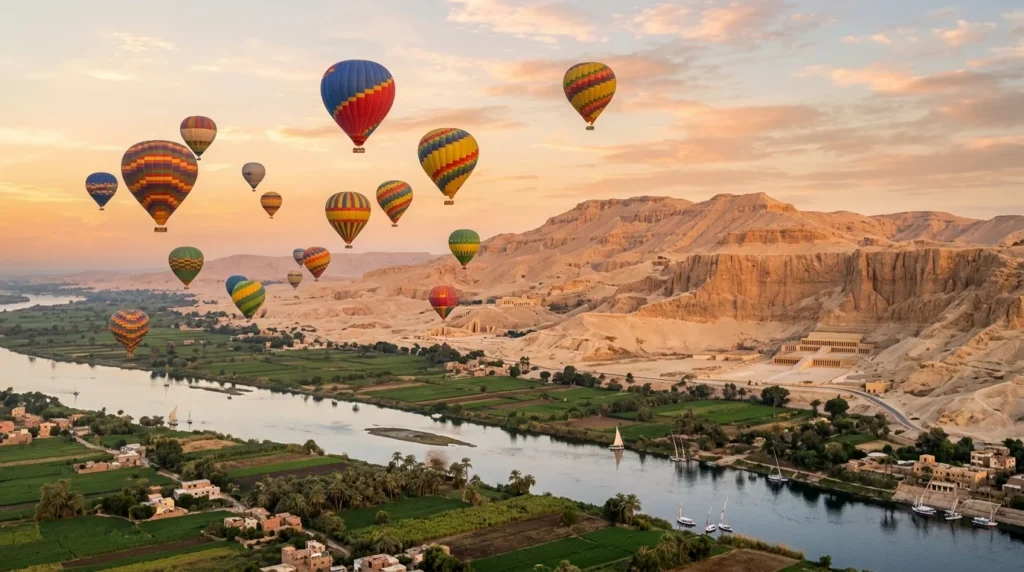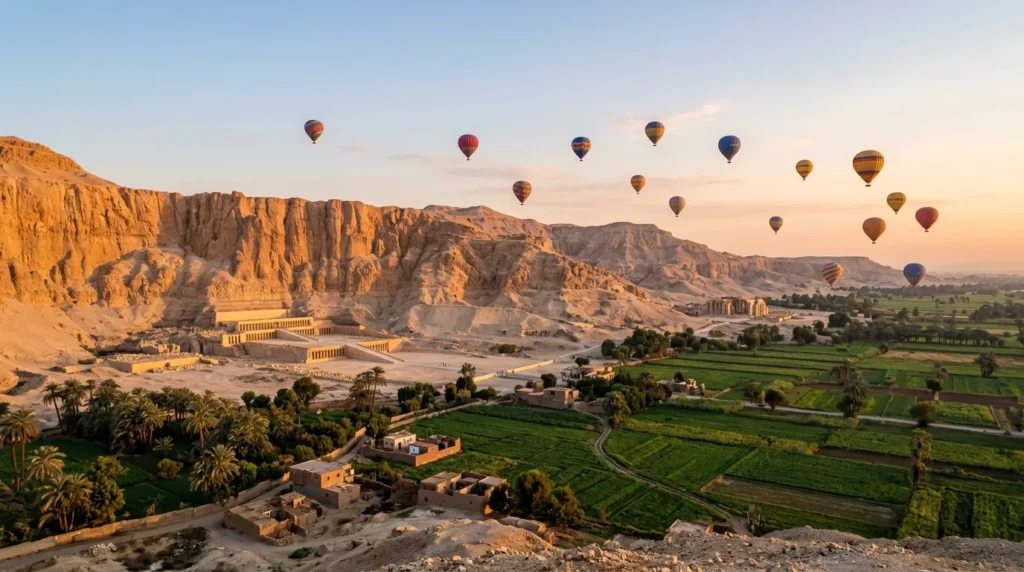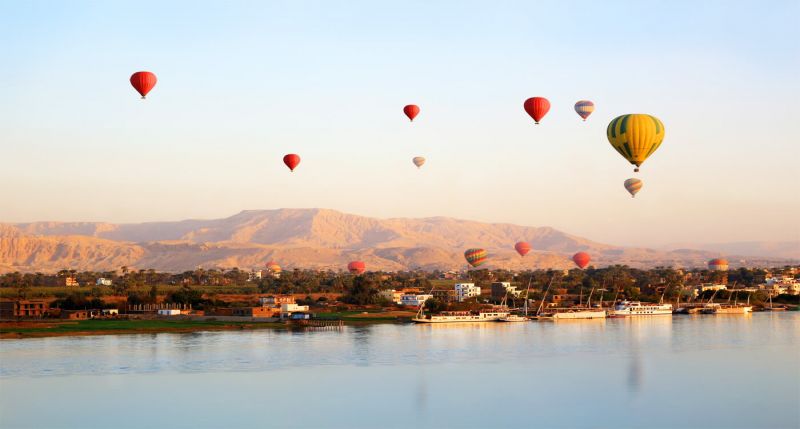
A Luxor balloon flight gives travelers an unbeatable view of Egypt’s greatest archaeological treasures. Floating gently above the West Bank reveals the true scale of the ancient Theban necropolis. Moreover, the golden morning light illuminates timeless temples and hidden royal tombs carved into rugged desert cliffs.
Why a Luxor balloon flight provides unmatched perspectives
Drifting above the Nile River brings the geography of ancient Thebes into sharp focus. For example, you immediately observe the stark dividing line between lush green sugarcane fields and barren desert mountains. Ancient Egyptians viewed this dramatic boundary as the border between life and death. Consequently, our team at Skyline Balloons in Luxor, Egypt greets travelers before dawn to share this breathtaking transformation.
Furthermore, standard ground tours cannot replicate the peaceful panorama of a morning basket ascent. Visitors often rush through crowded sites on foot. In contrast, a Luxor balloon flight lets you admire massive pylons, colonnades, and courtyards in complete serenity.
Panoramic views across the Theban Necropolis
Rising above the desert reveals the full expanse of the Theban Necropolis. In fact, this UNESCO World Heritage landscape spans miles of royal mortuary complexes. Moreover, pilots adjust altitude smoothly so guests can capture pristine aerial photos. You can easily plan your morning journey through our comprehensive tour options.
Soaring over Hatshepsut Temple during your Luxor balloon flight
The mortuary temple of Queen Hatshepsut at Deir el-Bahari stands out dramatically from the air. Its monumental sandstone terraces rise against vertical limestone cliffs. Therefore, viewing the site from above highlights the genius of its ancient architect, Senenmut. During your Luxor balloon flight, the rising sun hits the three tiered levels directly.
Additionally, the structure blends organically into the towering mountain backdrop behind it. From ground level, visitors admire the statues and relief carvings. However, an aerial vantage reveals how deliberately ancient builders aligned the central ramp with the Nile. Furthermore, the early morning shadows accent the symmetrical beauty of each colonnade.
Nearby, the older ruins of Mentuhotep II and Thutmose III come into view. Consequently, aerial observers can appreciate centuries of evolving temple architecture across one single desert amphitheater. A serene flight lets you absorb these rare historical layers without any distraction.
Spotting the Valley of the Kings on a Luxor balloon flight
The famed Valley of the Kings hides within a secluded desert gorge beneath the pyramidal peak of al-Qurn. Because ancient architects dug subterranean tombs deep underground, you will not see painted chambers from the air. Nevertheless, a Luxor balloon flight exposes the secretive topography that protected royal resting places for millennia.
Moreover, you can spot the winding modern access road and the visitor entrances to famous tombs. From above, it becomes obvious why pharaohs like Tutankhamun selected this dry wadi. In fact, the natural limestone peak above the valley served as a ready-made pyramid. Therefore, ancient rulers saved labor while securing eternal secrecy for their treasures.
Meanwhile, the balloon drifts southward along the mountain ridge toward neighboring ravines. You soon notice the distinct cleft of the Valley of the Queens. As a result, passengers gain a clear mental map of where New Kingdom rulers laid their royal families to rest.
Gazing at worker settlements in Deir el-Medina
Just south of the main valleys lies the ancient settlement of Deir el-Medina. In addition, this preserved mudbrick village housed the craftsmen who decorated the royal crypts. From aloft, the foundations of ancient family homes and small chapels appear razor-sharp against the yellow sand. If you want to check availability, visit our flight booking page.
Luxor balloon flight: Towering sentinels: Viewing the Colossi of Memnon
As the wind carries your basket eastward toward the cultivated fields, two massive stone giants suddenly dominate the landscape. These are the famous Colossi of Memnon. In fact, each monolith stands roughly sixty feet tall. They originally guarded the entrance to the sprawling mortuary temple of Amenhotep III.
Today, the main temple has largely vanished into history. However, these twin quartzite statues remain standing proudly amidst emerald-green farmland. Consequently, observing them during a Luxor balloon flight offers a startling sense of scale. The nearby farm tractors and palm groves look microscopic beside their weathered pedestals.
Moreover, early morning fog frequently clings to the surrounding irrigation canals. This gentle mist wraps the base of the statues in ethereal beauty. Therefore, photographers aboard the basket consistently rank this crossing as an unforgettable highlight of their trip.
Luxor balloon flight: The Ramesseum and Medinet Habu from the air
Two grand royal temples anchor the southern half of the West Bank flight zone. The first is the Ramesseum, built by the celebrated pharaoh Ramesses II. For example, from the sky you can clearly identify the shattered fragments of his colossal seated granite statue. In addition, the vast network of mudbrick storage vaults curving behind the temple shows how priests preserved temple wealth.
Similarly, the mortuary temple of Ramesses III at Medinet Habu commands instant attention. Thick fortified walls enclose this remarkable complex like a desert fortress. Furthermore, deep-cut hieroglyphs on the entrance pylon remain vivid even from hundreds of feet above. A Luxor balloon flight lets you admire the sheer volume of stone required to erect such massive enclosures.
Meanwhile, the contrast between the sandy temple grounds and adjacent agricultural plots becomes striking. Farmers often wave to passengers as baskets float quietly past date palms and sugar crops. For more travel tips, browse our balloon travel articles before your trip.
Comparing ancient architecture from above
Viewing these distinct sites back-to-back highlights how pharaohs competed for architectural supremacy. Ramesses III borrowed stylistic concepts heavily from Ramesses II. Nevertheless, Medinet Habu survived in far superior condition. Experiencing both structures from the air demonstrates their design evolutions in a single morning.
What to expect during your morning adventure
A memorable aerial tour begins well before the sun climbs over the eastern horizon. Our team picks up guests from their local hotel or cruise boat in Luxor, Egypt around dawn. After a brief safety briefing and river transfer, ground crews inflate the giant nylon envelopes with powerful burners. In fact, watching the colorful domes rise against the dark sky builds incredible anticipation.
Once aloft, your pilot steers through varying wind currents to showcase each landmark. A typical Luxor balloon flight stays airborne for approximately 45 minutes to an hour. Consequently, you have ample time to view tombs, temples, and village life as daylight spreads across Upper Egypt. If you have any questions about safety or scheduling, reach out directly to our support staff.
Finally, your pilot executes a smooth landing in the desert scrub or fallow agricultural fields. Ground crew members assist you from the basket with celebratory cheers. As a result, you return to your hotel in time for a hearty breakfast and further sightseeing.
A perspective you will cherish forever
Exploring Egyptian heritage from high above the desert floor creates memories that last a lifetime. The ancient architects designed these monuments to impress gods and mortals across centuries. Therefore, seeing them framed against mountains, desert sands, and the shimmering Nile gives timeless appreciation. Book your Luxor balloon flight today to witness these wonders from the best seat in Egypt.